Nuclear is eating the UK defence budget

The long wait for the UK's Defence Investment Plan (DIP) finally ended on the 30th June, disappointing almost everyone by not actually being a plan beyond the first four years, and not yet being "fully-funded". The 'Plan' leaves the UK's Armed Forces facing multiple capability gaps as equipment is retired before replacements are delivered, and by 2029 we will actually have fewer Armoured Vehicles, Combat Aircraft, Warships and Helicopters in service than we did in 2024. Yet the defence budget is increasing, so where's the money gone?
Where's the money gone? The 'Defence Nuclear Enterprise' (DNE), that's where...
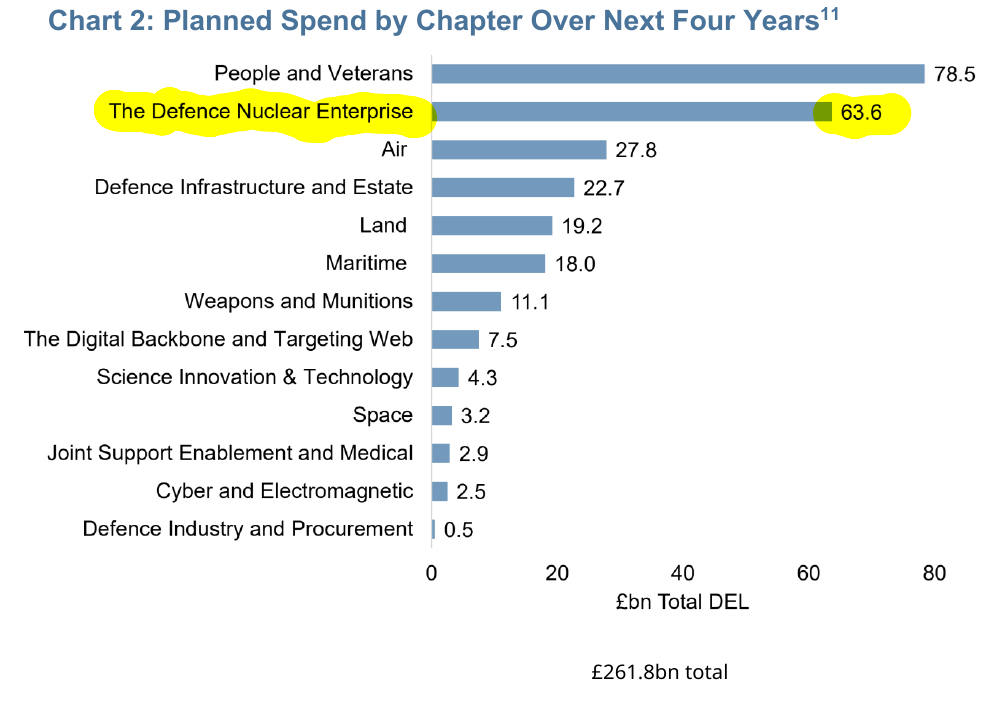
The forecast costs of the UK nuclear programmes have ballooned to an astonishing extent of the last few years. The DIP plans to spend nearly £64 billion on the DNE over just the next 4 years, accounting for 24% of the total defence budget.
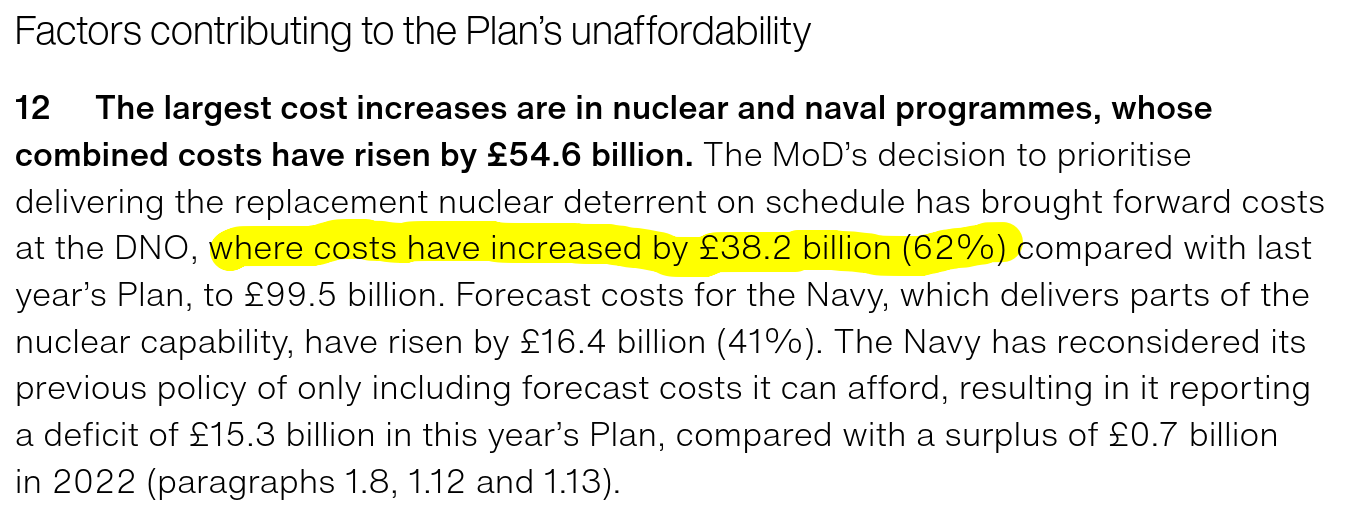
Yet if we look back to the last full Defence Equipment Plan from 2022, the forecast 10 Year cost for the then Defence Nuclear Organisation (DNO) was only £60bn. Since then, costs have virtually doubled, with the National Audit Office reporting in 2023 that DNO costs had increased by an incredible 62% (£38bn) in just one year alone after the MOD issued an 'Update on Affordability'.
But the cost increases haven't stopped there...
Looking at the DIP's forecast spend on the DNE from FY2026/27 to FY2029/30, the costs for those four years alone have increased by a further £10+bn in addition to that 2023 increase.
The 2023 NAO report introduced us to the infamous £16.9 billion 'black hole' in the equipment plan. During those same four years from FY2026/27 to FY2029/30, the under-funded 2023 Equipment Plan wanted to spend a total of £129bn (for nuclear and conventional defence) against a budget at the time of £115 billion - a £14 billion shortfall.
The 2026 DIP proposes a Capital Departmental Expenditure Limit (CDEL) for those same four years of £125bn, from which equipment procurement must be funded. Essentially, all of the CDEL spending increase funded since 2023 has gone to the DNE, leaving conventional equipment procurement still under-funded relative to the 2023 Equipment Plan.
This is the reason that despite the clear and present danger presented by Russia and other adversaries, the 2026 DIP does not provide any acceleration in the delivery of significant new and replacement conventional equipment (beyond drones) before 2030, and in some cases retirement of existing capabilities has been brought forward.
Where is the accountability?

We might expect some oversight by the National Infrastructure and Service Transformation Authority who are tasked with monitoring major projects, but while their Major Projects Annual Report reveals Amber or Red ratings for all of the major nuclear projects, there is little detail behind the rating, claiming commercial sensitivity and/or national security exemptions. Likewise, probing questions from Members of Parliament are routinely met with non-answers.
Governance of nuclear programmes is in the hands of the 'Defence Nuclear Board', Chaired by Permanent Secretary and Vice Chief of Defence Staff, and accountable to the 'Defence Board' which in turn is chaired by the Secretary of State. While there are also non-Executive Directors serving on the Defence Nuclear Board, it does rather look like governance is largely in the hands of insiders marking their own homework.
While respecting the sensitivity of the UK's nuclear programme, it can't be acceptable for expenditure of well over £100 billion over the next ten years, that has seen forecast costs double in only three years, to continue with so little oversight and scrutiny.
Are the cost increases justified? Does the programme deliver value for money? We don't know, but we do know that we are sacrificing the UK's conventional defence capabilities in order to fund it.
Fortunately in June of this year the Government announced that a new House of Commons committee will be established to conduct scrutiny of Defence Nuclear Enterprise expenditure and programmes. I hope it is allowed sufficient access to the information required to properly perform its function.
Comparison with France
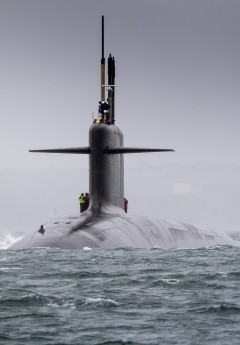
There is a ready benchmark available to compare the UK's nuclear programme - the French. Last year the French deterrent programme consumed about 13% of their defence budget. This compares to the UK's 18% of a larger total budget, so the UK is spending more than the French on nuclear deterrence. The French are forecasting their percentage to increase, but the UK's programme could reach 25% of the total defence budget in the coming years. And while there are differences in how costs are accounted for and which bucket they are in, the French programme also delivers four nuclear submarines carrying sovereign missiles and warheads, AND a tactical weapon in the form of the 'ASMP' nuclear-armed cruise missile. It's difficult to avoid the conclusion that the French nuclear deterrent programme currently delivers more capability for less money.
How did we get here?
A significant part of the problem was the large gap that was allowed to develop between nuclear submarine programmes. The last of the Trafalgar Class submarines was launched in 1991 and the last of the Vanguard Class in 1998, with production of the replacement Astute and Dreadnought Classes not starting until 2001 and 2016 respectively. The large gap in design and production work caused significant job losses at BAE Systems Barrow, along with essential skills and experience that significantly hampered progress with the new programmes and required significant regeneration of the workforce and production facilities at Barrow at substantial cost. The UK is now paying the price for previous industrial neglect and under-investment, whereas the French have traditionally paid greater attention to industrial strategy and capacity when planning their major defence programmes.
Maintaining the nuclear deterrent is the MOD's number one priority, and there is a pressing need to replace the ageing Vanguard Class in order to maintain the 'continuous at sea' deployment of at least one ballistic missile submarine. But that cannot mean that the Defence Nuclear Enterprise is given a blank cheque to spend an ever-increasing portion of the UK's defence budget without proper democratic scrutiny. Let's hope the new House of Commons Committee is promptly established and gets up to speed quickly.